Automation software is no longer something only developers and large companies use. Small businesses, freelancers, marketing teams and even solo creators now rely on automation to handle repetitive work. The problem is that many popular automation platforms become expensive as workflows grow, especially when several actions run every time a task is triggered.

Activepieces is one of the platforms trying to solve this problem. It combines a visual workflow builder with AI agents, app integrations, tables and self-hosting options. Instead of manually moving information between applications, users can build workflows that connect their tools and complete repetitive tasks automatically.
But is Activepieces actually a good alternative to Zapier, Make or n8n? Does its free plan offer enough for everyday use? And how much will it cost when your business starts running thousands of automations? This Activepieces review looks at the platform’s features, current pricing, practical use cases, advantages and limitations to help you decide whether it fits your needs.
What Is Activepieces?
Activepieces is a workflow automation platform that helps people connect different applications and automate tasks without building everything from scratch.
Its main feature is a visual automation builder. Users select a trigger, add actions and connect applications to create a workflow. For example, a new lead submitted through a form can automatically be added to a spreadsheet, entered into a CRM and forwarded to a sales representative. Activepieces also supports AI-powered workflows. These can summarize emails, classify incoming messages, extract information from documents and perform tasks using connected applications.
The platform currently advertises more than 760 integrations. Its core is open source under the MIT license, while certain enterprise capabilities use a commercial license.
Activepieces at a Glance
| Feature | Details |
|---|---|
| Software Type | Workflow and AI automation |
| Best For | Small businesses, teams, developers and agencies |
| Free Plan | Available |
| Paid Plans | Starting at $16/month, billed annually |
| Integrations | 760+ |
| AI Agents | Supported |
| Visual Workflow Builder | Yes |
| Self-Hosting | Available |
| Open Source | MIT-licensed core |
| API and Webhooks | Supported |
| Official Website | activepieces.com |
How Does Active pieces Work?
Activepieces uses a trigger-and-action system. A trigger starts an automation when something happens, while actions determine what the automation does next.
Imagine that you run a small online business. Every time a customer fills out a contact form, you want their details saved in Google Sheets and a notification sent to your team. Without automation, someone would have to copy the information and send the message manually. With Activepieces, you can connect the form, Google Sheets and your communication tool in one workflow. Once the workflow is published, the platform handles those steps when the trigger conditions are met.
This approach is useful because it allows businesses to create processes that work across multiple applications. You can begin with a simple two-step workflow and gradually add more advanced conditions, AI actions or external API calls.
Activepieces Key Features
1. Visual Workflow Builder
The visual workflow builder is the main reason many users consider Activepieces. Rather than writing a separate script for every automation, you build a sequence of connected steps.
Each workflow begins with a trigger. After that, you can add actions such as creating records, sending notifications, updating databases or processing information with AI.
This makes common automations approachable for people who do not have extensive programming experience. However, more complicated workflows still require an understanding of how data moves between applications, how APIs behave and what happens when a step fails.
2. More Than 760 App Integrations
Activepieces has a growing collection of integrations known as pieces. These connect the platform to popular productivity, marketing, sales and developer applications.
Examples include Gmail, Google Sheets, Slack, Notion, Airtable, HubSpot, Salesforce, Shopify, Stripe and OpenAI. The official integration directory lists 764 pieces at the time of review, with thousands of available actions. Importantly, Activepieces states that integrations are included across its plans rather than individually locked behind higher subscription tiers.
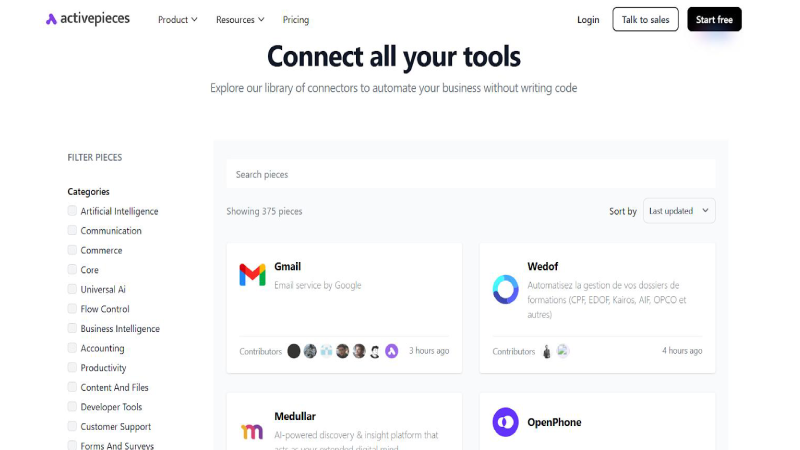
Having hundreds of integrations does not mean every application supports every possible action. Before moving an existing automation to Activepieces, check whether the specific triggers and actions you need are available.
3. AI Agents and AI Automation
AI functionality has become a more important part of Activepieces in 2026.
The platform supports agents that can use connected applications to perform tasks. It also includes AI actions for summarizing text, classifying information, extracting structured data and running agents inside workflows. A marketing team could use AI to categorize incoming leads. A support team could summarize customer messages before assigning them to the appropriate person. A business could extract information from invoices and send that data to another system.
In its September 2026 update, Activepieces introduced improvements for creating reusable agents from natural-language instructions. Users can describe what an agent should do, review the suggested configuration and edit it before publishing. These features can reduce manual work, but AI outputs should still be reviewed in important workflows. Automated classification, document extraction and AI-generated responses can make mistakes.
4. Self-Hosting Support
One of Activepieces’ most useful differences from cloud-only automation tools is the ability to run it on your own infrastructure. Its documentation recommends Docker Compose with PostgreSQL and Redis for self-hosted deployments. Kubernetes and other hosting methods are also documented.
Self-hosting can appeal to organizations that need more control over infrastructure, data location or deployment configurations. However, it also introduces responsibility for server maintenance, updates, backups and monitoring. The open-source Community Edition is not identical to every paid enterprise capability. Businesses requiring advanced governance should check licensing and plan requirements before choosing a deployment.
5. Tables and Shared Data
Activepieces includes Tables, which allow workflows and agents to work with structured data stored in rows and columns. This is useful for simple tracking systems, automation state, lead information and other internal workflow data.
For example, an automation could store processed records in a table so another workflow can use that information later. This can reduce the need for an external spreadsheet in some use cases, although it does not automatically replace a full CRM or relational database.
6. API, Webhooks and MCP Support
Activepieces is not limited to prebuilt integrations. It also supports APIs and webhooks for connecting services that are not available in its integration catalog.
The platform includes MCP functionality, allowing compatible AI clients to interact with connected tools. Its August 2026 update added natural-language tool discovery capabilities intended to help agents identify relevant actions across integrations.
For developers and technical teams, these features offer more flexibility than relying entirely on a fixed list of no-code connectors.
Activepieces Pricing 2026: How Much Does It Cost?
Pricing checked: October 9, 2026 · USD · Official pricing page
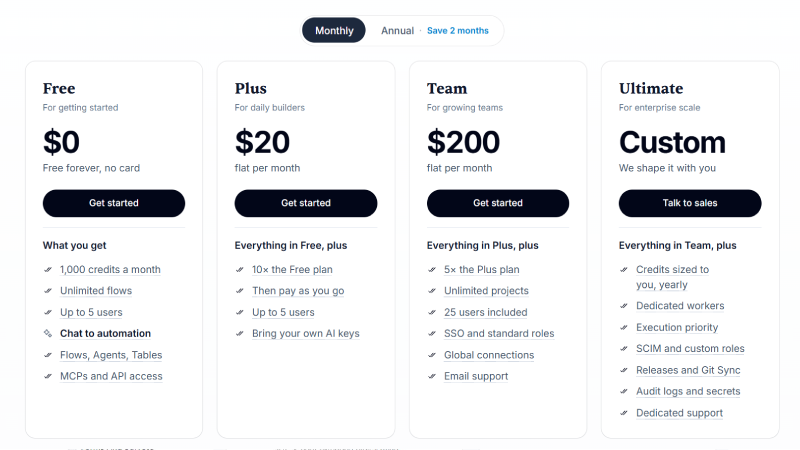
Activepieces uses a credit-based pricing model. According to its current pricing page, one credit generally covers a complete flow run regardless of the number of steps. Agentic actions have separate credit rules, so AI-heavy workflows can consume credits differently from ordinary automations.
Free Plan
The Free plan costs $0 and includes 100 credits per day, unlimited flows, agents, tables, MCPs and API access. No credit card is required to begin.
For someone experimenting with basic workflows or learning how the platform works, this is a useful starting point. The daily credit allowance may be enough for occasional automations, but businesses running frequent triggers will need to calculate their usage.
Plus Plan
The Plus plan starts at $16 per month when billed annually. It includes 10,000 credits per month and supports up to five users.
Additional credits are listed at $0.007 each. Users can also bring their own AI provider keys, which can change how AI actions are billed. Model-provider charges remain separate when using your own keys.
This plan is worth considering when your workflows run regularly and the free allowance becomes restrictive.
Team Plan
The Team plan costs $166 per month with annual billing. It includes 50,000 credits per month, 25 users, unlimited projects, SSO, standard roles, global connections and email support.
This tier is more suitable for organizations where multiple people depend on shared automation processes.
Ultimate Plan
Ultimate uses custom pricing and targets organizations that require stronger operational controls. Features include dedicated workers, execution priority, advanced identity management, audit logs and enterprise support.
Businesses considering this tier should request a quote based on expected usage, deployment requirements and governance needs.
For current details, visit the official Activepieces pricing page.
Is Activepieces Really Free?
Yes. Activepieces offers a free cloud plan, and its MIT-licensed core can be self-hosted through the Community Edition.
However, free cloud usage is subject to a daily credit allowance. Self-hosting also has potential expenses, including server resources, storage, backups and maintenance.
The important distinction is that open-source software does not necessarily mean every commercial feature is free. Enterprise capabilities can require a paid license, even when the software is installed on your own servers.
Activepieces Pros and Cons
| Pros | Cons |
|---|---|
| Free cloud plan available | Free plan has credit limits |
| Open-source core and self-hosting | Complex workflows require learning |
| Unlimited flows across plans | Self-hosting needs technical maintenance |
| 760+ integrations | Enterprise features require paid licensing |
| AI agents and automation tools | AI usage can introduce extra costs |
| Supports API and webhook workflows | Not every integration supports every action |
Activepieces vs Zapier vs Make vs n8n
vasilkoff.comImage placement: Before comparison table. Alt text: Activepieces vs Zapier vs Make vs n8n workflow automation platforms comparison.
| Platform | Main Strength | Ideal User |
|---|---|---|
| Activepieces | Open-source core, AI agents and flexible deployment | Small teams and technical businesses |
| Zapier | Broad integration ecosystem and approachable setup | Nontechnical business users |
| Make | Visual scenario design and data transformation | Marketing and operations teams |
| n8n | Flexible technical workflows and self-hosting | Developers and technical automation teams |
Activepieces vs Zapier
Zapier is well known for its extensive integration ecosystem and straightforward automation setup. For people who want to connect popular business applications without spending much time learning technical concepts, it can be a convenient option.
Activepieces is especially interesting for users who value open-source technology, self-hosting and control over deployment. Its current pricing model can also be attractive for multi-step workflows, although actual costs depend on usage. The best choice depends on whether your priority is broad app compatibility, setup simplicity, infrastructure control or long-term automation costs.
Activepieces vs Make
Make offers a visual approach to designing automation scenarios. It is useful when workflows require branching, filtering and data transformations. Activepieces also provides visual workflows but combines them with its open-source core, AI agents and self-hosting capabilities.
Teams evaluating both products should build the same real-world workflow in each platform. That provides a better comparison of available integrations, troubleshooting experience and monthly usage costs than comparing feature lists alone.
Activepieces vs n8n
n8n and Activepieces both appeal to users who want more control over their automation environment.
n8n is often considered for technical workflows involving APIs, custom logic and self-managed deployments. Activepieces is another option for teams seeking visual automation with an open-source foundation and integrated AI capabilities.
Neither platform should be considered universally better. The decision depends on your team’s technical skills, required integrations, governance needs and deployment preferences.
Who Should Use Activepieces?
Activepieces can be a practical option for several types of users.
- Small business owners: Repetitive tasks such as recording leads, updating customer information and sending notifications can be automated without creating separate software for each process.
- Marketing teams: Automations can connect forms, spreadsheets, CRM systems and messaging tools. AI steps can also help categorize incoming requests or summarize campaign information.
- Developers: API access, webhooks, custom integrations and self-hosting make the platform relevant to teams that need more flexibility than simple app-to-app automation.
- Agencies: Agencies managing automation for several clients may benefit from project organization and team features, although advanced separation, access controls and governance should be evaluated against the appropriate paid plan.
- AI automation builders: Users interested in agents that interact with business applications can experiment with AI-powered workflows while retaining control over the actions available to those agents.
How to Get Started With Activepieces
- Visit Activepieces.com and create a free account.
- Open the automation builder and create a new flow.
- Select a trigger, such as a new form submission or an incoming webhook.
- Connect the application account needed for the trigger.
- Add one or more actions, such as saving data or sending a notification.
- Test the workflow using sample data and review the output.
- Publish the flow when it works as expected.
Start with a simple workflow rather than immediately building a large process with many integrations. This makes it easier to identify configuration problems and understand how credits are consumed.
Is Activepieces Safe and Secure?
Activepieces provides cloud and self-hosting options, which can help organizations choose where their automation infrastructure operates. Its documentation describes governance features such as project permissions, SSO, SCIM, audit logs and secrets management, with availability depending on the plan.
According to its pricing page, the company uses encryption in transit and at rest. It also states that its SOC 2 program is in progress rather than claiming completed certification. Organizations handling sensitive information should review the current security documentation, deployment architecture and applicable compliance requirements before using the platform for production workloads.
Activepieces Alternatives Worth Considering
Besides Zapier, Make and n8n, businesses may want to evaluate Pipedream for developer-oriented integrations or Relay.app for workflows that involve human review and approval.
These platforms approach automation differently. The most useful comparison is to consider your actual workflows, expected run volume, integrations and maintenance requirements.
Frequently Asked Questions
Is Activepieces free to use?
Yes. Activepieces offers a free cloud plan with 100 credits per day. Its open-source Community Edition can also be self-hosted, although hosting and maintenance may have associated costs.
Is Activepieces better than Zapier?
Activepieces can be a better fit for users prioritizing open-source software, self-hosting and flexible deployment. Zapier may be more convenient for people who value a broad integration ecosystem and straightforward setup.
Does Activepieces require coding?
Basic workflows can be created using its visual builder without writing code. Advanced API integrations, custom pieces and complex logic may require technical knowledge.
Can Activepieces run AI agents?
Yes. Activepieces supports AI agents and AI actions that can work with connected applications. Users should review permissions, usage costs and outputs before allowing agents to perform important actions.
How many integrations does Activepieces support?
Its official integration directory currently lists more than 760 integrations. The available actions and triggers vary between applications.
Can I self-host Activepieces?
Yes. Activepieces supports self-hosted deployment. Docker Compose is one of the recommended installation methods.
Is Activepieces good for small businesses?
It can be a good option for small businesses that want to automate repetitive work without immediately committing to an expensive enterprise automation platform. The free plan makes it possible to evaluate basic workflows before upgrading.
What are the main disadvantages of Activepieces?
Potential disadvantages include credit limits, the learning curve for advanced automations, technical maintenance for self-hosted deployments and additional licensing requirements for some enterprise features.
Final Verdict: Is Activepieces Worth It in 2026?
Activepieces is worth considering if you want a workflow automation platform that combines visual building, AI capabilities, open-source technology and deployment flexibility.
Its free plan makes it accessible to people learning automation, while the paid plans introduce larger credit allowances and features for growing teams. The availability of more than 760 integrations means it can handle many common business processes without requiring custom software development.
The platform is not completely effortless, especially when workflows involve complex APIs, large volumes of data or self-hosted infrastructure. Users should also understand the credit model before moving business-critical automations.
For small teams and businesses willing to spend some time learning how automation works, Activepieces is a credible alternative to more established workflow tools. The most sensible approach is to test a real workflow on the free plan, check the available integrations and calculate the expected cost before committing to a paid subscription.