Academic research involves much more than finding a few papers and writing a summary. Researchers spend hours searching databases and reading studies before they can begin comparing evidence. Even after finding useful sources, they still need to organize references and evaluate methods. Preparing figures and formatting manuscripts can take additional time that might otherwise be spent developing research ideas.
AI tools have made some of these tasks easier, but general-purpose chatbots are not always designed for academic work. They can explain complicated concepts and help organize writing, yet their answers may contain references that do not exist or conclusions that are not properly supported by the original research. This becomes a serious problem when someone uses AI-generated information in a dissertation or journal manuscript without checking it.
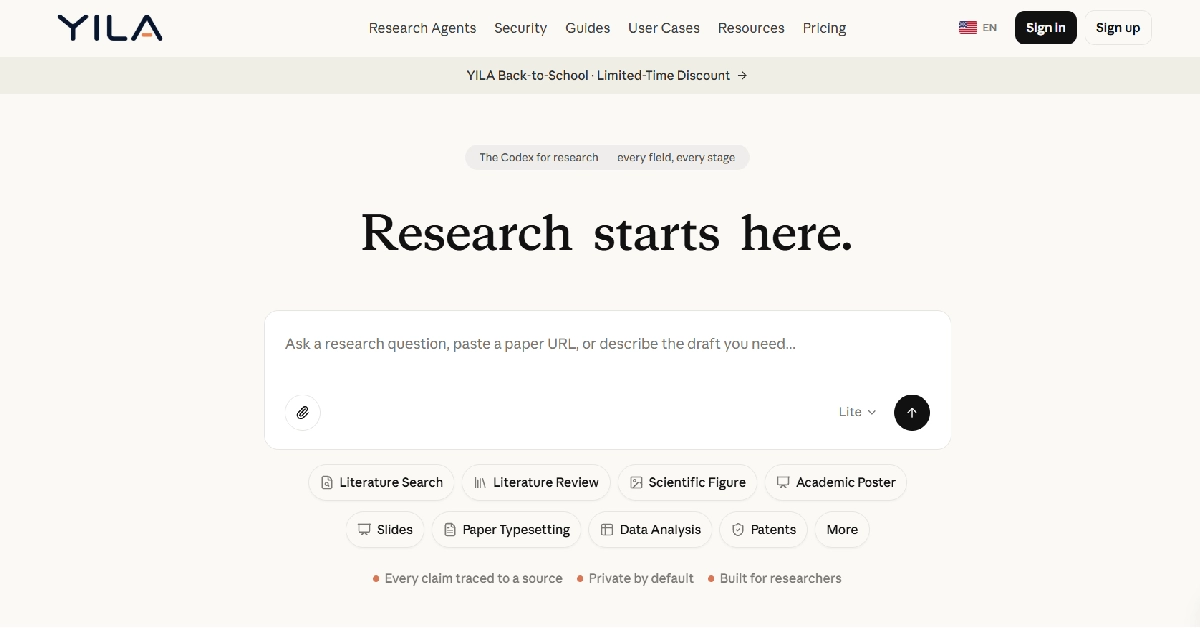
Yila AI is built around a different approach. Instead of functioning only as a chatbot that answers questions, it aims to support the research process from the initial literature search to the final presentation. The platform includes tools for finding papers and comparing evidence along with features for data analysis and scientific writing. It can also help researchers create figures and academic posters or convert papers into presentation slides.
One of its most interesting promises is source traceability. Yila says its research workflows connect claims to identifiable sources so users can examine the evidence behind a generated conclusion. This does not mean every output will automatically be correct. It does mean the platform is trying to address one of the biggest weaknesses of AI-assisted academic writing. In this Yila AI review, we will examine its main features and pricing along with the situations where it could be useful. We will also discuss its limitations and compare it with other research tools to help you decide whether it deserves a place in your academic workflow.
What Is Yila AI?
Yila AI is an AI-powered research assistant designed to support different stages of academic and scientific work. Its official website describes a platform that can search scholarly literature and analyze research papers before producing structured research outputs. Users can begin with a question or upload existing material depending on the task they want to complete.
The platform is organized around specialized research workflows. For example, someone preparing a literature review can ask Yila to search relevant academic sources and identify useful studies. Another researcher can upload a dataset and request exploratory analysis. Someone preparing for a conference can use the platform to develop figures or presentation materials.
What makes Yila different from a simple writing assistant is its emphasis on research deliverables. The platform aims to provide editable files such as documents and spreadsheets rather than only displaying answers in a conversation. Its official materials also emphasize keeping the steps behind a research output visible so users can inspect how the result was developed.
Yila AI at a Glance
| Detail | Information |
|---|---|
| Tool Name | Yila AI |
| Official Website | yila.ai |
| Tool Category | AI Research Assistant |
| Main Purpose | Academic Research and Scientific Writing |
| Literature Search | Yes |
| Literature Review | Yes |
| Research Paper Analysis | Yes |
| Data Analysis | Yes |
| Scientific Figures | Yes |
| Academic Posters | Yes |
| Presentation Creation | Yes |
| Manuscript Formatting | Yes |
| Paid Starting Price | $20/month |
| Annual Starting Price | $16/month equivalent |
How Does Yila AI Work?
Yila works by turning a research request into a sequence of tasks. Instead of immediately generating a long response from a short prompt, the platform is designed to interpret what the researcher needs and choose an appropriate workflow. A literature review request may involve searching for papers and screening the results before organizing evidence into a draft. A data analysis request follows a different process because it requires understanding the dataset before selecting a method. imagine a postgraduate student researching how generative AI affects university learning. The student needs more than a general explanation of the topic. They need published studies and information about how those studies were conducted. They also need to understand where researchers agree and which questions remain unanswered. Yila’s literature review workflow is designed to search for relevant research and organize the findings around these kinds of questions.
The platform’s official guide describes a process that begins with defining the research scope. Yila then retrieves candidate papers and selects core references before creating an evidence map and outline. The final review is produced with citations and supporting materials that users can inspect. According to Yila, a standard review typically takes around 9 to 15 minutes, although actual processing time depends on the scope and complexity of the task.
How to Get Started With Yila AI
- Visit the official Yila AI website and open the research workbench.
- Choose the research workflow that matches your task.
- Enter a research question or upload the relevant document.
- Specify the subject area and important research requirements.
- Review the proposed scope and available intermediate results.
- Examine the completed output and verify important sources before using it.
These steps describe the general process shown in Yila’s official guides. The available settings and exact workflow may vary according to the selected research task.
Yila AI Key Features in 2026
1. Academic Literature Search
Finding relevant research papers is one of the most time-consuming parts of academic work. A broad search can produce hundreds of results while a narrow search may overlook important studies. Researchers also need to distinguish credible evidence from papers that are only loosely related to their question. Yila provides a literature search workflow that gathers information from scholarly sources. According to its official documentation, these include OpenAlex and PubMed along with arXiv and Semantic Scholar. The platform also references Google Scholar and Crossref. Its goal is to build a candidate pool of papers that researchers can evaluate using information such as titles and abstracts.
This feature may be particularly useful during the early stages of a research project. Instead of searching every database separately, users can begin with one question and examine the collected results. However, researchers should not assume that a single automated search covers every relevant paper. Specialized databases and institutional resources may still be necessary for a comprehensive review.
2. AI Literature Review Generator
Yila’s literature review generator is one of its central features. The company says the workflow can retrieve and read more than 50 full research papers before comparing their methods and conclusions. It then organizes the evidence into a structured review with citations.
The important part is how the review is organized. A useful academic literature review should not simply summarize one paper after another. It needs to explain what the research collectively shows and where findings conflict. Yila’s workflow is designed to compare evidence across themes and identify unresolved questions.
The platform provides an example involving research on retrieval-augmented generation and factual accuracy. In that example, Yila describes screening 60 candidate papers and preparing a synthesis supported by 31 sources. The case study also shows an evidence matrix and source references. This is a demonstration published by the company rather than an independent benchmark of its performance.
3. Research Paper Deep Reading
Reading a complicated academic paper can take considerable time, especially when it contains unfamiliar methods or technical terminology. Yila offers a deep-reading workflow designed to help users understand a paper’s argument and supporting evidence.
Users can upload a PDF or provide a paper link. They can also explain why they are reading the document. For example, someone might want to decide whether a study belongs in their literature review or understand the limitations of a particular experiment. This feature could be useful when screening research papers before spending time on a detailed manual reading. However, the AI’s explanation should be treated as an aid rather than a replacement for the original paper. Important details such as sample selection and statistical assumptions still need to be checked directly.
4. Research Gap Identification
A research project becomes more valuable when it addresses a meaningful unanswered question. However, identifying a research gap is not as simple as finding a topic with few published papers. A gap might involve conflicting evidence or a population that has not been adequately studied.
Yila includes a research gap validation workflow intended to help researchers examine whether a proposed question is sufficiently supported and worth investigating. It can be used alongside literature search and evidence comparison to understand the current state of a topic. This may help postgraduate students refine broad ideas into more specific research questions. Nevertheless, the final decision should involve subject expertise and consultation with an academic supervisor. An AI-generated gap is not proof that a study is original or feasible.
5. Multi-Paper Evidence Matrix
When a literature review includes many studies, keeping track of their differences becomes difficult. One paper may use a small experimental sample while another relies on observational data. The conclusions may appear similar even though the underlying evidence is quite different.
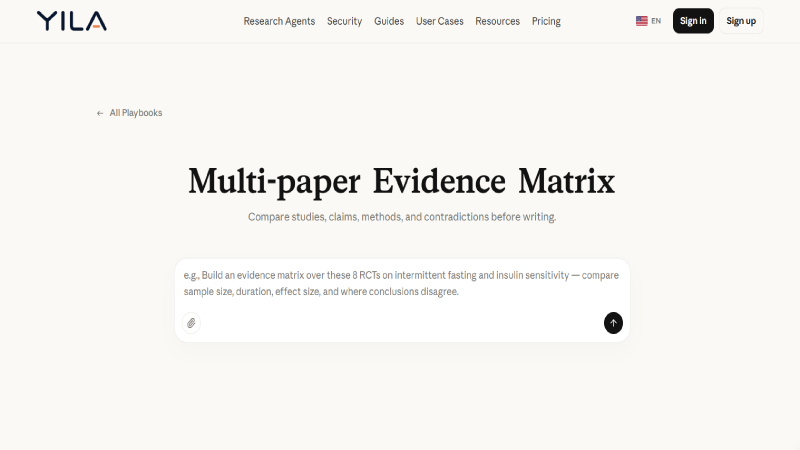
Yila provides a multi-paper evidence matrix that helps organize information across studies. Researchers can compare methods and findings while also examining limitations. This can be useful for identifying patterns and contradictions that might be missed when reading papers individually.
An evidence matrix is particularly valuable because it supports the researcher’s own judgment. Instead of accepting a polished paragraph as the final answer, users can examine the information used to build the synthesis.
6. Data Analysis Assistant
Research data often needs careful preparation before any statistical analysis can begin. A spreadsheet may contain missing values or inconsistent categories. Choosing a statistical test before examining these issues can lead to misleading results. Yila’s data analysis tools are designed to begin by inspecting the uploaded dataset.
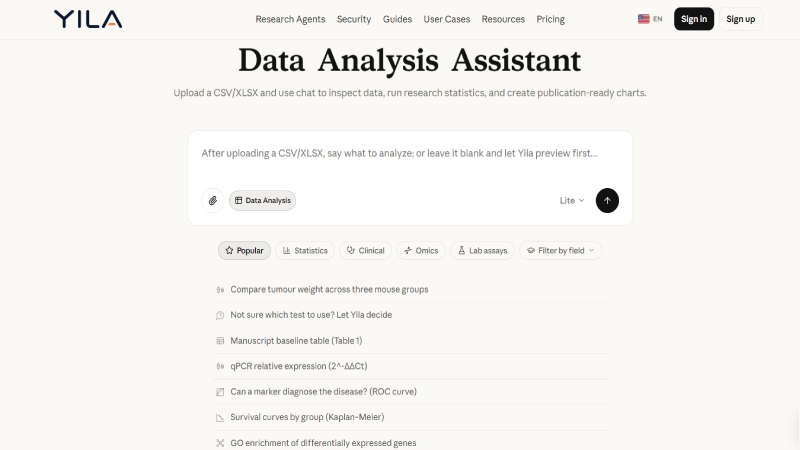
The platform supports CSV and XLSX files. According to its website, it can profile the data and select an analysis path based on the research question. It can then produce charts and tables along with reusable scripts. This is potentially useful for researchers who understand their subject but need assistance organizing a data analysis workflow. The most important limitation is that automated analysis still depends on the quality of the data and the appropriateness of the selected method. Researchers need to confirm whether assumptions are satisfied and whether the results answer the original question. Yila’s published examples show the intended workflow, but they should not be treated as proof that every statistical analysis will be correct.
7. Scientific Figure Generator
Scientific figures are an important part of research communication. A clear diagram can explain a complicated process more effectively than several paragraphs of text. Creating these visuals manually can be difficult when a researcher lacks design experience or access to specialized software.
Yila includes a scientific figure generator that accepts natural language instructions. Users can describe a mechanism or research workflow and request a visual representation. The official website says generated figures can be refined in the browser and exported in editable formats. This feature may be especially useful for preparing conceptual diagrams or research presentations. However, scientific accuracy matters more than appearance. Researchers should check labels and relationships carefully before including an AI-generated figure in a manuscript. A professional-looking diagram can still contain conceptual mistakes.
8. Academic Poster Generator
Preparing a conference poster involves deciding which parts of a research paper deserve the most attention. Researchers need to communicate the question and methods while making the results easy to understand. This is challenging when a full manuscript contains more information than a poster can reasonably display.
Yila offers a poster workflow that can use an uploaded research paper as its starting point. Users can choose a template and let the platform organize important sections into a poster layout. The output can then be edited before presentation. This could save time for students and researchers preparing conference materials. Still, a poster needs human review to ensure that results are represented accurately and that the design meets the event’s requirements.
9. Research Paper to Presentation Slides
Turning a research paper into a presentation requires more than copying paragraphs into slides. A useful academic presentation needs a clear narrative that introduces the research question and explains the methodology before presenting the findings. Yila includes a paper-to-slides workflow that organizes manuscript content into a presentation. The official website says it can produce editable PowerPoint files and include figures and key takeaways.
This may help researchers prepare for lab meetings and academic presentations. The output should still be adapted to the audience. A presentation for subject specialists may require different details from one intended for undergraduate students.
10. Manuscript Writing and Formatting
Academic writing involves several stages beyond preparing the initial draft. Researchers may need to revise individual sections and improve clarity before formatting the document according to a journal’s requirements.
Yila provides tools for manuscript section writing and journal-oriented polishing. It also includes typesetting features that can work with uploaded formatting requirements and templates. The company says the workflow aims to preserve tables and figures while preparing a document for its intended destination. This could be useful for researchers dealing with complex submission instructions. However, formatting requirements should always be checked against the latest official journal guidelines. Researchers also remain responsible for the originality and accuracy of their manuscripts.
Yila AI Pricing 2026: How Much Does It Cost?
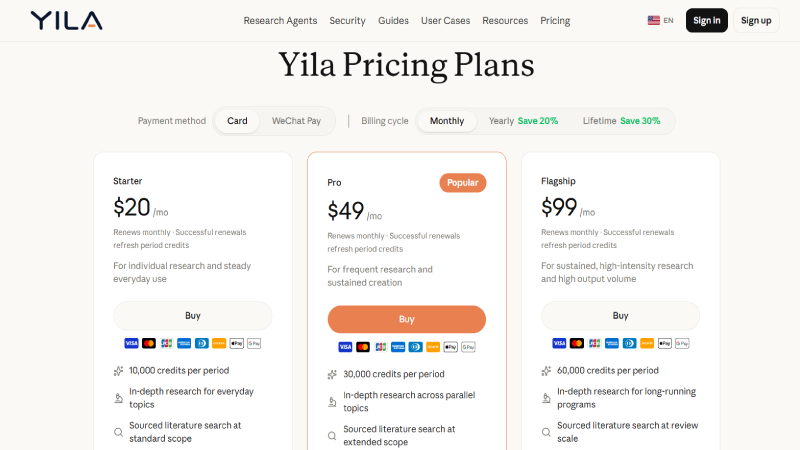
Yila uses a credit-based subscription model. Instead of charging separately for every research feature, its plans provide credit allowances that can be used for supported research tasks. The company currently lists Starter and Pro alongside Flagship.
The pricing page offers monthly and yearly billing. Yearly billing provides a lower monthly equivalent but requires an upfront annual payment. The exact number of tasks you can complete depends on the complexity of the work and the credits consumed.
Yila AI Pricing Comparison
| Plan | Monthly Billing | Yearly Equivalent | Credits |
|---|---|---|---|
| Starter | $20/month | $16/month | 10,000 monthly or 120,000 yearly |
| Pro | $49/month | About $39/month | 30,000 monthly or 360,000 yearly |
| Flagship | $99/month | About $79/month | 60,000 monthly or 720,000 yearly |
The annual checkout amounts shown by Yila are $192 for Starter and $470 for Pro along with $950 for Flagship. The Pro and Flagship annual equivalents are rounded in the company’s display.
Yila AI Starter Plan
Starter costs $20 per month with monthly billing or $192 per year. It is designed for individual researchers who need help with regular academic tasks but do not expect extremely high usage.
The monthly subscription includes 10,000 credits per billing period. Users receive access to supported research workflows with standard allowances for literature searching and scientific figures. The plan also includes standard customer support. Starter may be suitable for a student who occasionally needs assistance reviewing papers or preparing academic materials. However, someone working on several demanding literature reviews each month may need more credits.
Yila AI Pro Plan
Pro costs $49 per month with monthly billing or $470 per year. It provides 30,000 credits per monthly period or 360,000 credits under the annual plan.
The plan is intended for researchers who need to work on multiple topics and produce outputs more frequently. Yila advertises expanded research allowances and priority support. Pro may be appropriate for postgraduate researchers who regularly analyze papers and prepare research deliverables. The additional credits provide more flexibility but the value depends on how efficiently they are used.
Yila AI Flagship Plan
Flagship costs $99 per month with monthly billing or $950 per year. It provides 60,000 credits per monthly period or 720,000 credits on the annual subscription.
This plan is designed for intensive research activity. It includes larger allowances for literature searching and long-running tasks along with dedicated support. Flagship may be more relevant to researchers who need to process large amounts of information regularly. For someone who only prepares an occasional literature review, the additional cost may be unnecessary.
Does Yila AI Have a Free Plan?
Yila’s About page describes the product as being in an open free beta. However, its current public pricing page prominently lists paid Starter, Pro and Flagship subscriptions without clearly specifying a permanent free-tier credit allowance.
This means users should not assume that unlimited free access is available. The safest approach is to create an account and check the currently offered trial or introductory access before committing to a subscription.
How Do Yila AI Credits Work?
Credits are used to account for research activity. A simple task may require fewer resources than a literature review involving dozens of papers or a complex analysis project. Yila publishes allowances for different subscription levels but does not provide a universal fixed number of credits for every possible research request on the pricing page.
This makes it important to monitor usage during an initial project. A researcher who mainly asks short questions may have different needs from someone generating full reviews and multiple scientific figures.
Yila AI Pros and Cons
| Pros | Cons |
|---|---|
| Designed specifically for academic research | Not a replacement for independent source verification |
| Literature search across scholarly sources | Credit usage can be difficult to predict |
| Evidence-backed review workflow | Paid plans may be expensive for occasional users |
| Research paper analysis tools | Free access conditions are not fully clear |
| Scientific figure generation | Figures require accuracy checks |
| CSV and XLSX data analysis | Statistical results need expert validation |
| Academic posters and slides | Some workflows may take time to learn |
| Editable research deliverables | Independent performance evidence is limited |
Who Should Use Yila AI?
University Students
University students often need to read unfamiliar research papers and prepare assignments that require academic references. Yila may help them identify relevant literature and understand how studies relate to a particular question. Its paper-reading features could also help students approach difficult technical material more systematically.
Students should check their university’s rules on AI-assisted work. Some institutions permit AI tools for research organization but restrict their use in assessed writing. Using Yila responsibly means treating its output as research assistance rather than submitting generated material without independent review.
Master’s and PhD Researchers
Postgraduate researchers may find Yila particularly relevant because their work often involves large literature collections and repeated analysis. The evidence matrix and research gap workflows could help organize complex material before drafting a dissertation chapter.
Yila may also support tasks that become repetitive during a long research project. These include preparing figures and converting research findings into presentations. Its usefulness will depend on whether the generated materials meet the standards expected in the researcher’s discipline.
Academic Writers and Research Teams
Academic writers may use Yila to structure literature reviews and prepare manuscript sections. Research teams could also use its outputs as starting points for discussing evidence and planning further work.
The main benefit is organization rather than automatic authorship. A useful research assistant should help researchers understand the evidence and make better decisions. It should not be expected to determine the scientific validity of an entire project without human oversight.
Researchers Working With Data
Researchers who regularly work with spreadsheets may benefit from Yila’s data analysis features. The ability to generate charts and reusable scripts could make exploratory work more convenient.
anyone conducting statistical analysis should understand the underlying methods well enough to recognize inappropriate assumptions. An automatically generated result is not necessarily a valid scientific conclusion.
Yila AI vs Elicit Vs SciSpace vs Consensus
Yila competes with several established AI research tools. Each focuses on a different part of the research process.
| Tool | Main Focus | Suitable For |
|---|---|---|
| Yila AI | End-to-end research workflows | Literature reviews and research deliverables |
| Elicit | Literature research and evidence extraction | Reviewing academic studies |
| SciSpace | Paper reading and research assistance | Understanding scientific papers |
| Consensus | Research-backed question answering | Finding evidence on specific questions |
Yila AI vs Elicit
Elicit is designed to help researchers find papers and extract relevant information from academic studies. It can be useful when someone needs to compare evidence across several publications.
Yila also provides literature search and evidence organization but offers additional workflows for scientific figures and presentations. This broader scope may appeal to researchers who want several academic tasks in one environment. The better choice depends on the project. Someone primarily focused on evidence extraction may prefer a specialized workflow while another researcher may value Yila’s additional output formats.
Yila AI vs SciSpace
SciSpace is widely associated with helping users read and understand research papers. Its tools can be useful for explaining technical material and navigating academic literature.
Yila provides paper-reading assistance but also emphasizes structured research workflows that produce documents and other deliverables. Researchers who regularly prepare presentations or analyze data may find these additional capabilities relevant. Neither platform should be treated as a substitute for reading important original sources.
Yila AI vs Consensus
Consensus focuses on helping users explore questions through published research. It can be useful when someone wants to identify studies related to a particular claim.
Yila is positioned as a broader research environment. Its tools cover literature searching and review writing along with data analysis and academic presentation tasks. For quick research questions, a focused research search tool may be sufficient. For a project involving several stages and multiple deliverables, Yila may be worth evaluating.
Is Yila AI Reliable for Academic Research?
Reliability is one of the most important questions when evaluating an AI research assistant. A platform can generate well-written explanations and still make mistakes when interpreting evidence. This is especially concerning in academic work because readers expect claims to be supported by credible sources.
Yila emphasizes traceable citations and structured evidence workflows. Its official materials describe checking source details and connecting research claims to supporting papers. This is a useful design approach because it makes generated conclusions easier to examine. Traceability does not guarantee correctness. A real paper can be cited in support of a claim that it does not actually establish. Researchers still need to read the relevant passages and determine whether the interpretation is justified. Yila itself discusses this problem in its article about citation reliability.
The practical approach is to use Yila for finding and organizing evidence while keeping scientific judgment with the researcher. Important conclusions should be checked against the original publications. Data analysis outputs should also be reviewed before they are included in formal research.
Is Yila AI Safe to Use?
Yila states that research materials are private by default and that uploaded information can be traced to its source when used in an output. These are useful product commitments but users should review the current privacy policy before uploading confidential or unpublished work.
Researchers may handle sensitive information such as participant data or unpublished findings. Such material should not be uploaded to an external service without confirming that the use complies with institutional rules and applicable agreements. It is also sensible to avoid uploading personal identifiers when they are not necessary for the task. Research teams should understand how files are processed and retained before relying on any cloud-based AI platform.
Is Yila AI Worth It in 2026?
Yila AI is worth evaluating if academic research is a regular part of your work. Its strongest appeal is the combination of literature search and evidence organization with tools for data analysis and research presentations. Having these workflows in one platform could reduce the need to switch between several specialized applications.
The pricing deserves careful consideration. Starter begins at $20 per month while Pro and Flagship are aimed at more frequent use. Because the platform uses credits, researchers should test representative tasks and examine their actual consumption before deciding which subscription provides enough capacity.
The platform may offer less value to someone who only needs occasional explanations of research papers. A simpler research assistant or direct use of academic databases may be sufficient for that purpose. For researchers working on larger projects, Yila’s structured approach is more interesting. Its ability to produce editable materials and preserve evidence relationships could make it a useful addition to an established research workflow.
Frequently Asked Questions
What is Yila AI used for?
Yila AI is used for academic research tasks including literature searching and research paper analysis. It also supports scientific figures and data analysis along with academic writing and presentations.
Is Yila AI free?
Yila has described itself as being in an open free beta. However, its public pricing page currently lists paid subscriptions and does not clearly confirm a permanent free allowance.
How much does Yila AI cost?
Starter costs $20 per month and Pro costs $49 per month. Flagship costs $99 per month. Annual subscriptions offer lower effective monthly prices.
Can Yila AI write literature reviews?
Yes. Yila provides a literature review workflow that searches and organizes academic evidence before producing a structured draft with citations.
Does Yila AI provide real citations?
Yila is designed to use identifiable academic sources and provide traceable references. Users should still verify citations and check whether each source supports the associated claim.
Can Yila AI analyze Excel files?
Yes. Yila supports XLSX and CSV files for its data analysis workflows.
Can Yila AI create scientific figures?
Yes. Yila includes a scientific figure generator that can create visual explanations from natural language instructions.
Can Yila AI create PowerPoint presentations?
Yes. The platform provides academic presentation tools that can produce editable PowerPoint files.
Is Yila AI suitable for PhD students?
It may be useful for PhD researchers who regularly review literature and prepare research deliverables. Its value depends on the project and the researcher’s requirements.
Is Yila AI better than Elicit?
Yila offers a broader set of research creation workflows while Elicit focuses heavily on literature research and evidence extraction. The best choice depends on the tasks you need to complete.
Final Verdict
Yila AI offers an interesting approach to academic research assistance. Instead of focusing only on writing or answering questions, it provides workflows for searching literature and organizing evidence. It also supports data analysis and scientific presentation tasks that researchers commonly perform during a project.
The most promising aspect is its focus on source traceability. Academic research requires more than fluent writing and a tool that helps users inspect the evidence behind a claim has a meaningful advantage over one that only produces polished text. the accuracy of individual outputs still needs to be checked. Its credit-based pricing is another factor to consider. The Starter plan may be enough for occasional research work while Pro and Flagship provide larger allowances for regular use. Users should evaluate actual credit consumption before committing to an annual subscription.
Our verdict
Yila AI is a promising platform for researchers who want several academic workflows in one place. It is worth testing for literature reviews and research organization, especially when editable deliverables are important. However, it should remain an assistant rather than the final authority on research findings.
This review is based on Yila’s official website and published documentation. It does not claim independent hands-on testing or verified performance benchmarks.