Website analytics should help you understand what is happening on your site. Yet many website owners spend more time trying to understand their analytics software than using the information it provides. Between complicated reports, unfamiliar metrics and privacy settings, something as simple as checking which blog posts attract visitors can become surprisingly frustrating.
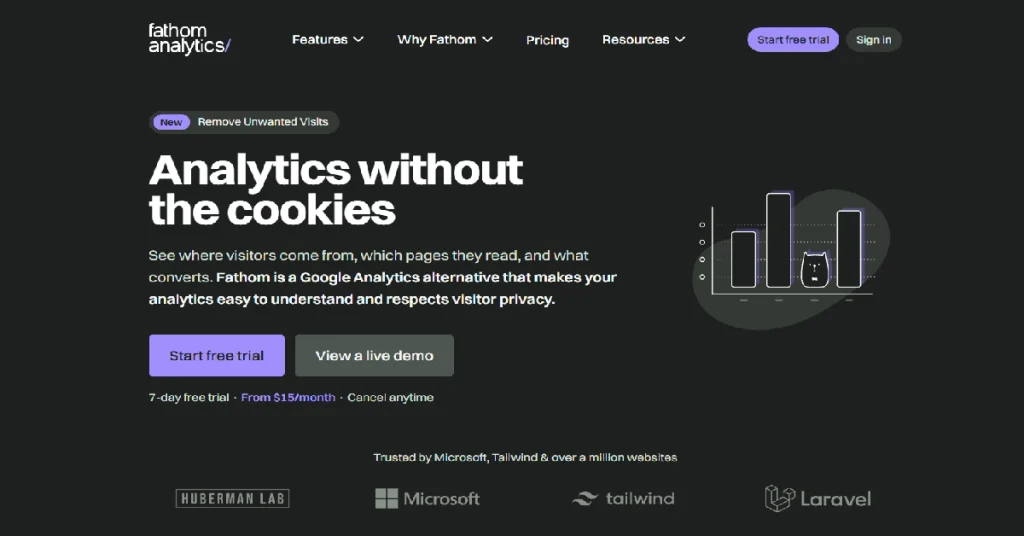
Fathom Analytics takes a different approach. It focuses on showing the numbers that matter without turning website tracking into a complicated project. You can see where visitors come from, which pages they read and whether they complete important actions. The dashboard is designed to make this information easy to find, even if you are not an analytics specialist. Privacy is another major reason people consider Fathom. Unlike traditional tracking systems that depend heavily on cookies and individual user profiles, Fathom is built around anonymous website measurement. It aims to give businesses useful traffic information without collecting unnecessary personal data.
The obvious question is whether that simplicity is worth paying for when Google Analytics is available for free. Fathom starts at $15 per month, which may feel unnecessary for a small personal blog. For a business that values clear reports and a privacy-focused setup, however, the cost may be easier to justify. In this Fathom Analytics review, we’ll look at its features and current pricing, what changed in 2026 and where it falls short. We’ll also compare it with Google Analytics and Plausible to help you decide whether it makes sense for your website.
What Is Fathom Analytics?
Fathom Analytics is a privacy-focused website analytics platform designed to provide useful traffic data without tracking individual visitors across the internet. It is a hosted service, so users do not need to maintain their own analytics servers or manage complex data infrastructure. The platform tracks website visits and pageviews alongside traffic sources, popular pages and conversion events. Its dashboard presents these metrics in a straightforward layout that makes it easier to understand performance without navigating through several layers of reports.
Fathom is developed by a Canadian company and places considerable emphasis on privacy compliance. The company says its analytics are designed to meet requirements under regulations including GDPR, ePrivacy, PECR and CCPA. It also automatically processes European visitor data through European infrastructure. Fathom is not trying to reproduce every feature available in Google Analytics. Its appeal comes from providing enough information for everyday website decisions while keeping the interface and tracking setup relatively simple.
Fathom Analytics at a Glance
| Feature | Details |
|---|---|
| Official Website | usefathom.com |
| Starting Price | $15/month |
| Free Plan | No |
| Free Trial | 7 days |
| Cookie-Free Tracking | Yes |
| Real-Time Analytics | Yes |
| Event and Revenue Tracking | Yes |
| Google Search Console Integration | Yes |
| AI Referral Tracking | Yes |
| Email Reports | Yes |
| WordPress Support | Yes |
| Data Export and API | Yes |
| Starting Site Allowance | 50 websites |
What Makes Fathom Analytics Different?
The biggest difference is how little effort it takes to understand the dashboard. When you open Fathom, you are not greeted with dozens of reports that require a course to interpret. The important numbers are visible together, and you can explore specific pages or traffic sources when you need more detail.
For a blogger, this means checking whether a new article is attracting visitors without spending much time configuring reports. For a SaaS founder, it means understanding which campaigns lead to signups. Agencies can also use the platform to prepare straightforward traffic reports for clients who are not interested in technical analytics terminology.
Fathom also avoids using tracking cookies. According to the company, this allows its analytics to operate without requiring a cookie consent banner solely for Fathom tracking. However, websites using advertising pixels or other tracking services may still need consent mechanisms, depending on applicable law. The result is a product that prioritizes clarity over collecting every possible data point. That approach will appeal to some businesses, although others may need the deeper reporting capabilities of a more complex analytics platform.
Fathom Analytics Key Features
1. Simple Real-Time Dashboard
Fathom’s dashboard shows visitors and pageviews along with traffic sources, popular pages and other useful metrics. Real-time reporting lets you see current activity without waiting for the next day’s analytics update. This is especially useful after publishing a blog post or launching a campaign. You can quickly check whether visitors are arriving and identify the sources sending them to your website.
Fathom also offers filtering and saved views. If you regularly check traffic from a particular country or marketing campaign, you can save that view rather than rebuilding the same filters each time.
READ MORE: OpenAI Dots Review 2026: Is This Always-On AI Agent Worth It?
2. Privacy-Friendly, Cookie-Free Tracking
Privacy is central to Fathom’s design. The platform does not use tracking cookies to follow individual visitors. Instead, it uses privacy-preserving methods to measure website activity without building personal browsing profiles. For businesses serving customers in Europe, Fathom’s automatic EU data isolation is particularly relevant. Visitor data from covered European regions is processed on European infrastructure by default.
This simplifies one part of analytics compliance, but it does not make every website automatically compliant with every privacy regulation. Other services installed on the site and the business’s own data practices still matter.
3. Event and Revenue Tracking
Pageviews tell you how many times people visit a website, but they do not tell you whether visitors take useful actions. Fathom supports custom events for activities such as newsletter subscriptions and form submissions or purchases.
You can also attach monetary values to relevant events. This allows businesses to see conversion activity alongside ordinary traffic metrics. a digital product seller might track purchases while a newsletter publisher monitors signups. These events help answer a more meaningful question than how many visitors arrived: what did those visitors actually do?
4. Google Search Console Integration
One of Fathom’s notable 2026 improvements is its Google Search Console integration. Website owners can connect Search Console to view search-related information alongside their analytics. This is useful for publishers who want to understand which search queries and pages bring visitors from Google. Instead of switching between two dashboards for every basic question, they can examine relevant search information within Fathom.
The integration does not replace all of Google Search Console’s technical SEO reports. You will still need Search Console for tasks such as indexing and coverage diagnostics. But for everyday content performance analysis, the connection is a welcome addition.
5. AI Referral Traffic Tracking
As AI search and conversational tools become part of how people discover websites, publishers increasingly want to know whether these platforms send visitors to their content. Fathom added a dedicated AI traffic view in October 2026. It groups referral traffic from services such as ChatGPT, Claude, Gemini and Perplexity so website owners can examine those visits separately.
This is particularly relevant for content websites and SaaS companies trying to understand changes in discovery. However, referral reporting cannot identify every instance in which an AI assistant mentions a website. It measures visits with identifiable referral or campaign information, not all AI-generated recommendations.
6. Campaign Tracking and Email Reports
Fathom supports UTM campaign tracking, allowing users to identify visitors coming from newsletters and paid advertising or social media promotions. You can filter the dashboard to see how a particular campaign performs and whether it leads to conversions.
The platform also offers automated email reports. Agencies can send clients regular summaries without requiring them to sign in to the analytics dashboard. This is a practical feature for small teams because it reduces the time spent manually preparing recurring traffic updates.
7. Fathom V4 and Luna AI Assistant
Fathom V4 was introduced in 2026 with improvements to the underlying analytics engine. The update added entry and exit page reporting and improved filtering alongside more flexible data exports and better engagement measurement.
In October, Fathom also introduced Luna, an AI assistant available through the dashboard. Users can ask questions about how Fathom works or about their statistics, with access to those statistics controlled by user permission. Luna is a helpful addition for people who want quick explanations without learning every part of the interface. Still, it should be seen as an assistant for understanding analytics rather than a replacement for business judgment.
Fathom Analytics Pricing 2026
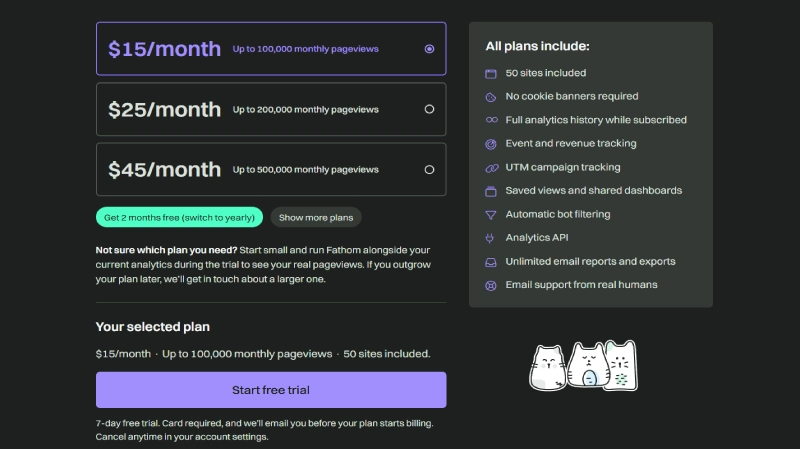
Fathom uses pageview-based pricing rather than charging separately for most features. Every plan includes the core analytics tools, and the subscription cost depends primarily on the total monthly usage across your websites.
Here are the current prices listed on the official pricing page.
| Monthly Allowance | Monthly Price |
|---|---|
| Up to 100,000 pageviews | $15 |
| Up to 200,000 pageviews | $25 |
| Up to 500,000 pageviews | $45 |
| Up to 1 million pageviews | $60 |
| Up to 2 million pageviews | $100 |
| Up to 5 million pageviews | $140 |
| Up to 10 million pageviews | $200 |
| More than 25 million | Custom pricing |
Annual billing offers approximately two months free. The $15 monthly plan therefore works out to about $150 per year when paid annually.
The entry plan includes up to 50 websites, which makes it particularly attractive for freelancers and agencies managing multiple smaller projects. Additional sites can be purchased in packs of 50 for $10 per month. One detail worth understanding is that custom events count toward your monthly usage allowance, not just pageviews. If your site records a large number of conversion events, your total billable usage may be higher than the pageview number alone suggests.
Is Fathom Analytics Free?
No. Fathom does not offer a permanent free plan. Instead, it provides a seven-day free trial with access to its features.
A credit card is required to begin the trial. If you do not cancel before it ends, your subscription starts billing automatically. Fathom says it sends a reminder before the first charge.
Fathom Analytics Pros and Cons
| Pros | Cons |
|---|---|
| Clean, easy-to-understand dashboard | No permanent free plan |
| Cookie-free, privacy-focused analytics | Less detailed than GA4 for complex analysis |
| Real-time traffic reporting | Seven-day trial is relatively short |
| Google Search Console integration | Advanced attribution needs may exceed its scope |
| AI referral tracking | Events count toward usage limits |
| Supports multiple websites | Paid subscription may not suit hobby sites |
| Automated reports and data exports | No self-hosted option |
| Lightweight tracking script | Some custom events require setup |
Fathom Analytics vs Google Analytics vs Plausible
Choosing an analytics tool comes down to how much information you need and how much time you are willing to spend managing it.
| Feature | Fathom Analytics | Google Analytics 4 | Plausible |
|---|---|---|---|
| Starting Cost | $15/month | Free standard version | Paid plans |
| Main Focus | Simple, privacy-first analytics | Detailed marketing analytics | Lightweight, privacy-first analytics |
| Cookie-Free Approach | Yes | Not its default traditional setup | Yes |
| Real-Time Reports | Yes | Yes | Yes |
| Conversion Tracking | Yes | Yes | Yes |
| Learning Curve | Low | Higher | Low |
| Best For | Publishers, small businesses and agencies | Advanced marketing teams | Privacy-focused website owners |
Fathom vs Google Analytics
Google Analytics 4 provides a more extensive set of tools for businesses that need detailed event analysis and integrations with Google’s advertising ecosystem. It is powerful, but understanding its reports can take time.
Fathom is a better fit for people who mainly want to know where traffic comes from and which pages or campaigns perform well. Its interface makes everyday questions easier to answer without extensive configuration. If your business depends on advanced attribution and detailed audience analysis, GA4 may remain the more appropriate choice. If you value simplicity and privacy, Fathom deserves consideration.
Fathom vs Plausible
Plausible is another popular privacy-focused analytics platform. Both tools aim to provide useful website statistics without the complexity of traditional analytics software. Fathom may appeal to users who want its specific dashboard experience, reporting features and managed infrastructure. Plausible is worth comparing if you prefer its approach to analytics or want to evaluate self-hosting options.
Neither is automatically better for every website. The most useful comparison is to run both on a test site and decide which dashboard answers your questions more clearly.
Who Should Use Fathom Analytics?
Fathom makes the most sense for website owners who want reliable traffic information without spending much time managing analytics. Bloggers and independent publishers can use it to understand which articles attract readers and where those readers come from.
It is also well suited to small SaaS businesses that want to measure signups and campaign performance without implementing a complex analytics system. Agencies may appreciate the ability to manage multiple websites and share reports with clients.
For ecommerce businesses, Fathom can track important conversion events, but it may not provide all the detailed customer journey reporting that a larger marketing operation requires. Companies with complex attribution needs should evaluate those requirements before switching.
How to Install Fathom Analytics on WordPress
Setting up Fathom on WordPress is relatively straightforward. You create a Fathom account, register your website and add the tracking script using a supported WordPress integration or the installation method described in Fathom’s documentation.
After installation, visit your website and check the real-time dashboard to confirm that pageviews are being recorded. It is also worth testing any custom events you plan to use, such as contact form submissions.
You can run Fathom alongside Google Analytics during the trial. This makes it easier to compare reporting and decide whether the simpler dashboard provides enough information for your needs.
Is Fathom Analytics Worth It in 2026?
Fathom Analytics is worth considering if you value simplicity and visitor privacy more than having every possible analytics feature. The platform does a good job of keeping everyday website reporting understandable, and its 2026 updates make it more useful for publishers and businesses.
The addition of Search Console data and AI referral reporting is especially relevant for content-driven websites. These features help users understand how visitors discover their pages without introducing the complexity of a full marketing analytics suite.
The main drawback is pricing. Google Analytics remains free for standard use, while Fathom starts at $15 per month. That difference matters for a website generating little revenue. However, for a business that regularly uses its analytics data, paying for a simpler workflow may be reasonable.
Frequently Asked Questions
Is Fathom Analytics better than Google Analytics?
Fathom is easier to use for basic website reporting and focuses on privacy. Google Analytics offers more advanced analysis and advertising integrations. The better option depends on your needs.
Does Fathom Analytics use cookies?
No. Fathom uses a cookie-free tracking approach designed to measure website activity without identifying individual visitors.
How much does Fathom Analytics cost?
Fathom starts at $15 per month for up to 100,000 monthly pageviews, with higher plans available for websites receiving more traffic.
Does FathIs Fathom Analytics GDPR compliant?om Analytics work with WordPress?
Yes. Fathom supports WordPress websites and provides installation guidance for adding its tracking script.
Can Fathom track traffic from ChatGPT?
Yes. Fathom introduced AI referral reporting in October 2026, allowing users to examine identifiable traffic from ChatGPT and other AI services.
Is Fathom Analytics GDPR compliant?
Fathom states that its analytics service is GDPR compliant and uses privacy-preserving measurement. Overall website compliance still depends on the other technologies and data practices involved.
Can I import Google Analytics data into Fathom?
Yes. Fathom provides an importer for bringing historical GA4 data into its platform.
Final Verdict
Fathom Analytics is a good choice for website owners who want to understand their traffic without dealing with complicated reporting tools. Its privacy-focused approach and straightforward dashboard make it particularly attractive for publishers and smaller businesses.
The 2026 updates have made the platform more capable without losing its focus on simplicity. Search Console integration and AI referral tracking add useful information, while event tracking and automated reports cover many everyday business needs.
Our verdict
Fathom Analytics is worth trying if you want a cleaner alternative to Google Analytics and can justify the $15 monthly starting price. It may not replace GA4 for advanced marketing teams, but for straightforward website analytics, it offers a compelling balance of simplicity and useful features.
Editorial note: This review is based on official product documentation and pricing, not an independent hands-on test.