
For a long time, search visibility was relatively easy to describe. A business wanted to rank for valuable keywords, attract visitors from Google and turn those visitors into customers. Marketing teams monitored rankings, organic traffic, backlinks and conversions. The numbers did not tell the entire story, but they provided a familiar way to judge whether search marketing was working.
That picture has become more complicated. Someone researching accounting software might ask ChatGPT to compare several products. A marketing manager might use Perplexity to identify agencies with experience in a particular industry. A buyer researching a new laptop might read Google’s AI-generated answer before deciding which websites to visit. In each case, the buyer could discover a brand without encountering a conventional list of search results.
This creates an uncomfortable question for businesses that have invested heavily in SEO. What happens when a company performs well in Google but rarely appears in AI-generated recommendations? Traditional analytics may show that website traffic is stable, but they cannot always explain why a competitor keeps appearing in AI answers or which sources influence those recommendations.
What Is Profound AI?
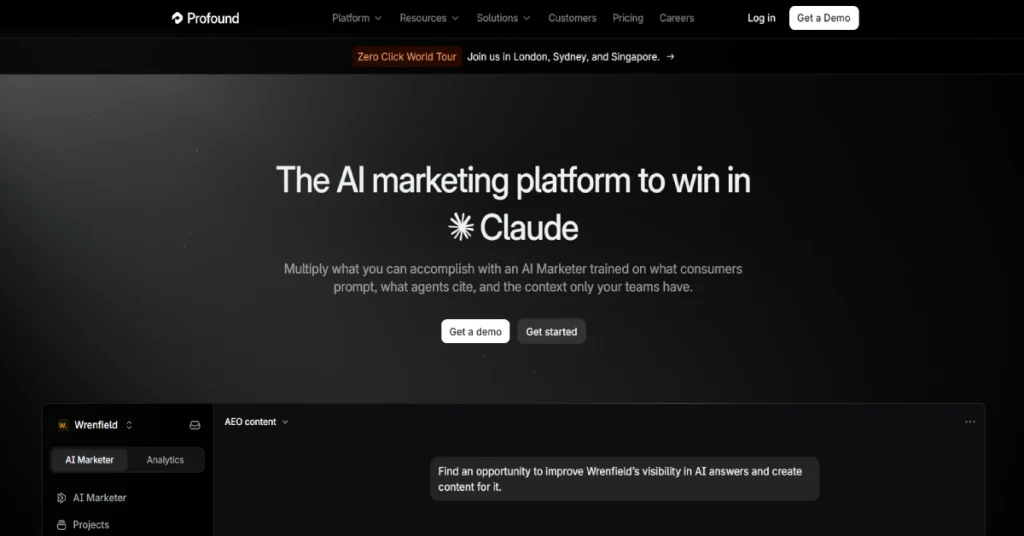
Profound is an AI search visibility and marketing platform that helps businesses understand how their brands appear in responses generated by AI systems. It is designed for a world where product discovery increasingly happens through conversational questions rather than only through traditional search keywords.
The basic idea is different from conventional rank tracking. A keyword ranking tool might tell you that a page appears in fifth position for “best customer support software.” Profound attempts to answer a broader set of questions: Does the brand appear when someone asks an AI assistant for customer support software? Which competitors are recommended alongside it? What websites are cited? Does the answer describe the brand accurately? And how does that visibility change over time?
Profound’s platform includes Answer Engine Insights, Prompt Volumes, Agent Analytics, Pages and Agents. These features cover different parts of the same problem. Some help marketers understand what users are asking. Others show where brands appear, which pages receive citations or how AI crawlers interact with a website. The agent-based features are intended to help teams act on those findings rather than leaving them inside reports. Profound+1
It is important to understand what Profound is not. It is not a replacement for Google Search Console, and it does not guarantee that a brand will appear in ChatGPT or Gemini. It also does not reveal the complete internal reasoning of an AI model. Instead, it measures observable answers and related signals to help marketers make more informed decisions. For businesses already familiar with SEO, Profound can be understood as a specialized layer of AI search research and optimization. It addresses questions that conventional ranking reports were not originally designed to answer.
Profound AI at a Glance
| Detail | Information |
|---|---|
| Product | Profound |
| Category | AI Search Visibility / Answer Engine Optimization |
| Main purpose | Track and improve brand visibility in AI-generated answers |
| Free trial | Yes |
| Trial allowance | 50 prompts run daily for 7 days |
| Paid pricing | Enterprise custom quote |
| Supported platforms | Up to 9 answer engines on Enterprise |
| Prompt research | Yes |
| Competitor monitoring | Yes |
| Citation analysis | Yes |
| AI crawler analytics | Yes |
| Content optimization | Yes |
| Marketing agents | Yes |
| Enterprise SSO | Yes |
| Official website | Profound |
Pricing note: Some older Profound pages still mention Starter and Growth plans. The current public pricing page emphasizes Trial and custom Enterprise pricing. Confirm any alternative plan directly with sales before publishing a price.
Why AI Search Visibility Matters in 2026
Imagine that you run a software company selling project management tools to small businesses. Your website ranks for several valuable Google keywords, and your blog receives consistent organic traffic. From a conventional SEO perspective, the strategy appears to be working.
Now imagine that a potential customer asks an AI assistant, “What project management software is best for a ten-person consulting agency that needs client access and time tracking?” The assistant recommends three competitors and never mentions your product. That buyer may never search for your brand, even if your website has strong Google rankings.
This is the kind of visibility gap that Profound attempts to identify. The problem is not necessarily that the company’s SEO strategy has failed. It is that customers now discover products through several different interfaces, and those interfaces do not always select or describe brands in the same way. AI-generated answers also introduce uncertainty. A conventional search result has a recognizable position, while a conversational answer can change depending on the wording of the question, the platform, the region and the time of observation. A brand may appear in one answer but disappear from another that asks essentially the same question.
That makes repeated measurement important. Checking ChatGPT manually once a month is unlikely to provide a reliable picture of a brand’s presence across different customer questions. A structured monitoring system can help identify patterns, although it cannot eliminate the variability inherent in generative AI.
There is also a commercial distinction worth remembering. Being mentioned in an AI answer is not the same as receiving website traffic. A user may read a recommendation and leave without clicking anything. Another may remember the brand and visit its website days later. Marketers therefore need to examine visibility alongside referral traffic, branded searches, conversions and sales outcomes. Profound is most valuable when those measurements are connected. Its reports can help explain where a brand appears in AI discovery, but the business still needs to determine whether that visibility is contributing to meaningful results.
Profound AI Features Explained
1. Answer Engine Insights: Tracking Brand Visibility
Answer Engine Insights is one of Profound’s core capabilities. It allows marketers to monitor how a brand appears in AI-generated responses for selected prompts. Instead of manually entering the same questions into several AI platforms, teams can establish a structured set of prompts and review the resulting answers over time.
Consider a company selling customer relationship management software. It might monitor prompts about affordable CRMs for startups, CRM systems for real estate agencies and alternatives to more established products. The goal is not merely to count how often the company’s name appears. It is to understand which customer needs are associated with the brand and where competitors have a stronger presence. Profound supports daily prompt tracking and allows users to organize prompts by topics, personas, regions and other segments. This is useful because visibility can vary substantially between different customer groups. A product might be recommended for small businesses but rarely appear in enterprise-focused discussions. Without segmentation, those differences can become hidden inside an overall visibility score.
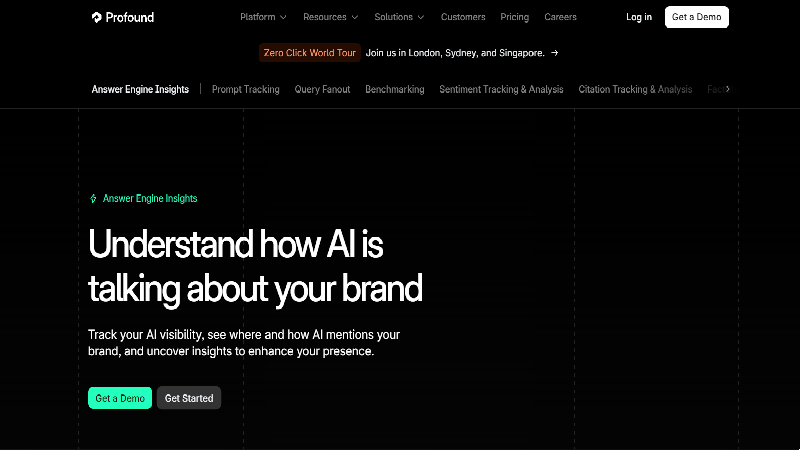
The ability to inspect actual answers matters as much as the numerical reports. A brand mention may look positive in a dashboard but be unhelpful in context. For example, an AI assistant might describe a product as suitable only for beginners when the company also sells enterprise software. The brand has technically appeared, but the positioning may be inaccurate.
This is where Profound can support more useful marketing decisions. A company can investigate whether its website explains enterprise capabilities clearly enough or whether independent sources continue to describe the product in outdated terms. There is an important limitation. AI answers are variable, and tracked prompts represent a selected sample of possible conversations. A visibility score should not be interpreted as the exact percentage of all AI users who encounter a brand. It is a measurement within a defined monitoring framework.
2. Prompt Volumes: Understanding What People Ask AI
Traditional keyword research begins with search phrases. A marketer enters a topic into an SEO tool and reviews estimated monthly searches, related keywords and competition. That approach remains useful, but conversational AI introduces a different style of question.
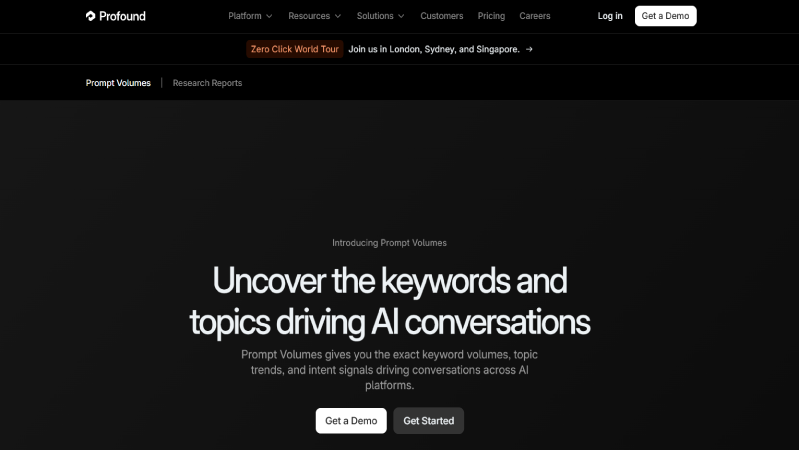
Someone might search Google for “best CRM for startups.” In ChatGPT, the same person could ask for a CRM suitable for a small consulting company with five employees, limited technical support and a specific monthly budget. The longer question contains useful information about the buyer’s circumstances and what they actually want from a product. Profound’s Prompt Volumes feature is designed to help marketers investigate this kind of demand. The company says its research draws on anonymized, aggregated data from double-opt-in consumer panels and combines signals across AI platforms. Its official documentation describes coverage that includes ChatGPT, Gemini, Claude and Perplexity, with multi-region research and weekly data updates.
This could be valuable for content planning. A software company might discover that potential customers frequently ask about implementation time rather than the features its marketing team has been emphasizing. Another business might find that buyers care more about integrations and ongoing costs than the broad product category. Those findings can influence product pages, comparison articles and FAQs. Instead of publishing generic content around every keyword variation, a marketing team can focus on questions that reveal meaningful purchase considerations.
prompt volume estimates require careful interpretation. Panel-based research is not a complete record of every private conversation across all AI platforms. The figures can indicate relative interest and emerging patterns, but they should not be treated as an exact census of global AI usage. For smaller websites, this distinction is particularly important. A topic may appear frequently in conversational research but still have limited direct search demand for a specific review article. Keyword tools, customer interviews and existing website analytics remain useful companions to Profound’s data.
3. Competitor Analysis and AI Share of Voice
One of the most useful questions in marketing is not simply whether a brand is visible, but why a competitor appears more often in the situations that matter. Profound helps teams compare their presence with competing brands across selected AI prompts. A company can investigate which products appear for particular customer needs, how frequently they are mentioned and whether their positioning differs.
Imagine a cybersecurity company that competes with three established vendors. It might find that its product appears in AI responses about affordable security software but rarely appears when users ask about enterprise compliance. That difference could reveal a genuine positioning problem, an information gap or simply the stronger public presence of competitors.
The appropriate response is not always to create a new article. Sometimes the company’s existing documentation is difficult to navigate. Sometimes important product capabilities are described only in sales presentations rather than on accessible web pages. In other cases, independent publications may not yet have covered the product’s newer features.
Competitive visibility research can help marketers prioritize these issues. It provides a starting point for investigating where a brand’s public information may be incomplete. Still, there is a danger in treating share of voice as a competition that must be won at any cost. A brand can increase mentions for broad informational prompts without attracting the customers it actually wants. Commercial relevance matters more than appearing in every possible answer.
4. Citation Analysis: Understanding Which Sources Matter
When an AI answer includes citations, those references can offer useful clues about where the system is obtaining information. A product recommendation might reference a manufacturer’s website, a software comparison page, a review publication or a technical document.
Profound’s citation analysis helps marketers examine these sources and identify patterns. If competing products are repeatedly supported by independent reviews, a business may discover that its own external coverage is limited. If an outdated product page keeps appearing, the company may need to update the information or improve how newer documentation is organized.
For example, a project management company might notice that AI answers frequently cite articles comparing task management features. If its own product is missing from those comparisons, the marketing team can investigate whether the articles are outdated or whether the company has failed to communicate relevant capabilities. This does not mean marketers should pressure publishers into adding brands to every list. Independent editorial coverage should remain independent. The more sustainable approach is to provide accurate product information, useful documentation and genuinely relevant material that publishers and customers can evaluate.
Citation analysis also has a technical limitation. Not every AI answer provides citations, and visible references do not reveal every influence on a model’s response. A cited page may support part of an answer without being the sole reason a brand was recommended. Profound’s value lies in making these patterns easier to investigate, not in proving a simple cause-and-effect relationship between a particular webpage and a recommendation.
5. Agent Analytics: Seeing How AI Systems Interact With Your Website
AI visibility is not limited to the answers people read. It also involves how AI systems access information from websites. Profound’s Agent Analytics focuses on interactions involving AI crawlers and referrals. The platform offers server-side integrations that can help businesses understand how supported AI systems interact with their content. This is different from conventional web analytics, which generally concentrate on visits and actions performed by human users.
Profound documents integrations with infrastructure providers including Vercel, Cloudflare, AWS CloudFront, Fastly and Netlify. These connections use server-side request information rather than depending entirely on a browser analytics script. Profound That distinction matters because an AI crawler does not behave like a normal website visitor. It may request content without executing JavaScript in the way a browser does. Conventional analytics can therefore miss parts of that activity.
For technical marketing teams, crawler information can help investigate whether important pages are accessible and how frequently AI systems request them. It may also reveal differences between content that is being crawled and content that is actually being cited.
a crawler visit is not proof that the page influenced an AI-generated answer. Similarly, a page that receives little visible crawler traffic may still be represented through other sources or previously acquired information. The most useful analysis combines crawler data with citation patterns, page quality and actual referral traffic. Each signal answers a different question, and none should be treated as a complete measurement of AI discovery on its own.
Granola AI Review : Is This Bot-Free AI Notetaker Worth Using?
6. Pages: Finding Which URLs Need Attention
A brand-level visibility report can tell a company that it has a problem, but it may not identify which webpage needs improvement. This is where Profound’s Pages feature becomes relevant. Pages reorganizes AI visibility information around individual URLs. It helps teams examine citation share, content quality and related signals at the page level. With Agent Analytics enabled, the platform can also provide additional crawler information and benchmarking.
This is useful for large websites because the marketing team may be responsible for hundreds or thousands of pages. Knowing that a competitor appears more often in AI answers is interesting. Knowing that a particular comparison page has weak citation performance and outdated information is more actionable. Profound describes content evaluation factors including readability, freshness, structure, information density, machine readability and answerability. The platform can suggest improvements and connect those recommendations to its agent-based workflows. Profound
These recommendations should be reviewed carefully. A machine-generated content score is not the same as editorial quality. A page can be concise, technically well structured and still fail to answer the reader’s most important question. Conversely, a detailed expert article may not fit every automated scoring preference. The strongest approach is to use the recommendations as diagnostic clues. If a page lacks a clear explanation of pricing or important product limitations, that is worth addressing because it helps readers. If a suggestion merely encourages adding repetitive keywords or generic text, it may not improve the page.
7. Profound Agents: Moving From Research to Action
A common weakness of analytics platforms is that they are excellent at identifying problems but leave the difficult work to someone else. A report might reveal that a brand is missing from important conversations, but the marketing team still needs to investigate why, decide what to change, prepare content and coordinate publication. Profound’s Agents feature attempts to shorten that process. The platform includes a configurable workflow builder that allows marketers to connect research, AI prompts, web information and other steps into automated processes. The official product documentation describes tools for citation research, content generation and knowledge-base retrieval.
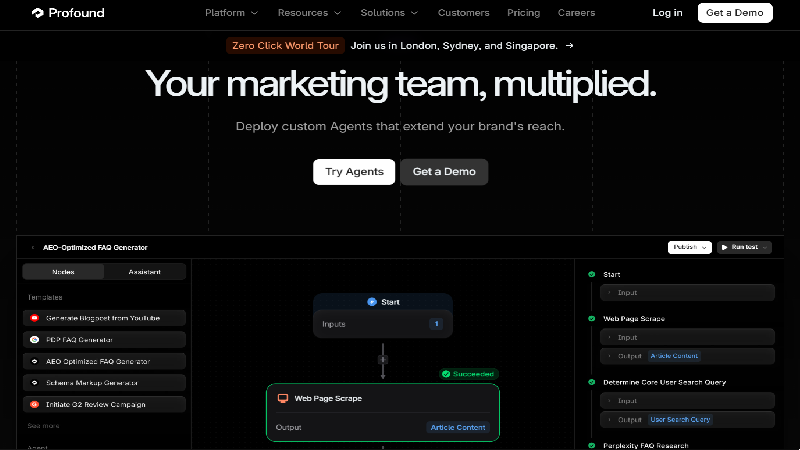
For a marketing team, a practical use might involve investigating a group of prompts where competitors appear frequently. An agent could help gather relevant source material, identify gaps in existing content and prepare a draft for editorial review. Another workflow might support recurring research around a product category or competitor. The advantage is not simply that AI can write an article. Plenty of general-purpose AI tools already do that. The more interesting possibility is connecting content work to the visibility data that identified the opportunity in the first place.
That said, automation creates risks when it is allowed to publish without adequate oversight. AI-generated material may contain outdated product details, unsupported claims or explanations that sound plausible without being accurate. A workflow can also reproduce the same weaknesses across dozens of pages if the underlying instructions are poor. For organizations publishing information about healthcare, finance, legal matters or other sensitive subjects, editorial review is particularly important. Profound’s agent tools may accelerate research and preparation, but accountability for published content remains with the organization.
8. Multi-Region and Multilingual Monitoring
A brand can have very different levels of recognition across countries. A software company may be well known in the United States but have little visibility among buyers in Germany or France. A product may also be described differently depending on the language and context of the question.
Profound supports multi-region and multilingual visibility monitoring. Its Answer Engine Insights documentation describes coverage across more than 150 regions and 30 languages, depending on the relevant plan and configuration. Profound
This can help international marketing teams investigate whether their brand positioning is consistent across markets. For example, a company entering a new country may want to know which local competitors appear in AI recommendations and whether its translated product pages provide enough relevant information. localization is not simply translation. Buyers in different markets may care about different payment methods, regulations, support arrangements or integrations. An English-language comparison page translated word for word may not address those local concerns.
9. Enterprise Security and Administration
Profound handles commercially sensitive marketing information, including competitive research, internal content workflows and potentially data from connected infrastructure. Larger organizations therefore need to consider access control and security before adopting it. Profound’s Enterprise documentation describes SOC 2 Type II compliance, single sign-on, role-based access control, API access, automated backups and premium support. These capabilities can help companies manage who has access to particular information and how the platform fits into existing systems. Profound
The company also publishes a data processing agreement that identifies service providers involved in processing and infrastructure. Organizations should review those terms when evaluating how their information will be handled. Security certification is useful evidence of established controls, but it does not mean every integration or workflow is automatically appropriate for every organization. Teams should still examine permissions, retention requirements and the consequences of allowing marketing agents to access or publish content.
How to Use Profound AI for a Real Marketing Project
Consider a fictional B2B company called Northstar CRM. It sells customer relationship management software to consulting agencies and professional service firms. Its website already receives organic traffic, but the marketing team suspects that AI assistants are recommending larger competitors when buyers ask for software suggestions.
The team could begin by defining the questions that matter commercially. Instead of monitoring only broad prompts such as “best CRM,” it might track questions about affordable CRM software for consulting firms, CRM tools with project management integrations and alternatives to more expensive enterprise platforms. These questions reflect different buyer needs. A small consulting firm may care about price and ease of setup, while a growing agency may care about reporting and integration with existing software. Grouping prompts by these needs can help the team understand where the brand is relevant.
Next, the team could examine the AI answers and citations. Suppose Northstar appears frequently in affordability-related answers but rarely appears when buyers ask about integrations. The team might discover that its website has a detailed integrations directory, but the most important connections are not explained on its main product pages.
The marketing response should begin with the actual information gap. The company could improve its integrations page, publish clearer implementation examples and make sure its product documentation answers common customer questions. It should not immediately produce twenty near-identical articles repeating the same claims. After the changes are published, the team could continue monitoring the relevant prompts. It might observe improved visibility, no meaningful change or increased mentions in only certain categories.
All three outcomes provide information. Improvement suggests the work may be helping, although other factors could also contribute. No change may indicate that the content has not been discovered or that stronger external evidence is needed. Mixed results may reveal differences between customer segments. the company should compare those observations with commercial data. Are more visitors arriving from AI referrals? Are branded searches increasing? Are sales representatives hearing that customers discovered the company through an AI recommendation?
This is where Profound can become useful as part of a broader measurement process. The platform helps investigate AI discovery, while the business determines whether that discovery produces meaningful results.
Profound AI Pricing 2026: How Much Does It Cost?
Pricing is one of the biggest considerations in this review because Profound has used different subscription structures over time.
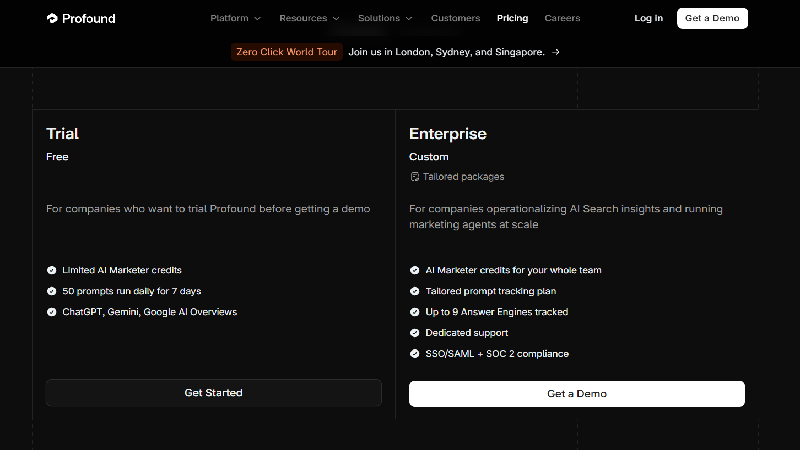
Older Profound materials describe Starter and Growth plans, including publicly advertised monthly prices. However, the current public pricing page prominently lists a free Trial and a custom-priced Enterprise option. It would be misleading to present an older Starter price as a currently available checkout offer without confirmation.
The current official pricing page lists:
| Plan | Price | Included details |
|---|---|---|
| Trial | Free | 50 prompts run daily for 7 days |
| Enterprise | Custom quote | Tailored prompt tracking, up to 9 answer engines, team AI Marketer credits, dedicated support and enterprise controls |
The trial covers selected AI experiences including ChatGPT, Gemini and Google AI Overviews. Enterprise packages provide broader coverage and customized allowances. Profound
Is the Profound Free Trial Worth Trying?
The free trial is useful because it allows a business to investigate a defined set of questions before committing to a sales conversation. Fifty monitored prompts can provide a meaningful starting sample when they are chosen carefully. The temptation is to fill the allowance with every broad question related to the business. That approach can produce a large amount of information without revealing much about actual customers.
A better trial focuses on a few commercially important categories. For example, a software company might reserve some prompts for direct product comparisons, others for industry-specific use cases and the remainder for questions involving its strongest competitors. The seven-day duration is enough to understand the interface and examine an initial visibility picture. It is not enough to establish a reliable long-term trend or prove that content changes have improved AI recommendations.
What Does Profound Enterprise Include?
Enterprise is designed for organizations that need ongoing monitoring and more advanced marketing workflows. The official pricing page describes tailored prompt tracking, support for up to nine answer engines, AI Marketer credits for teams, dedicated support and enterprise security capabilities. The actual value depends on the agreement. A company monitoring a small number of product categories has different requirements from an international retailer tracking hundreds of brands and product lines.
Before requesting a quote, businesses should establish how many prompts they need, which regions matter, how many people require access and whether they intend to use Profound’s marketing agents. Those decisions influence whether the platform becomes a useful operational system or an expensive reporting subscription.
Questions to Ask Before Buying Profound
Because Enterprise pricing is customized, buyers should request a written explanation of what is included. The most important questions concern tracked prompt allowances, engine coverage, regions, historical data, AI agent usage and whether additional charges apply when usage increases.
It is also worth asking about onboarding, data exports, integrations and contract terms. A platform may look affordable when evaluated by a small marketing team but become more expensive when additional business units or regions are included. Organizations should also clarify whether their proposed plan includes the particular features demonstrated during a sales call. Not every capability shown on a product website is necessarily available in every commercial agreement.
Is Profound Expensive Compared With Other AI Visibility Tools?
The answer depends on the type of business evaluating it.
For a small website that earns most of its revenue through affiliate articles, an enterprise AI visibility platform may be difficult to justify. The site owner may benefit more from improving existing reviews, publishing accurate comparisons and using affordable tools to monitor a smaller number of prompts.
For a large B2B software company, the calculation can be different. If a single enterprise customer is worth tens of thousands of dollars, identifying a significant gap in AI product recommendations may be commercially important.
Even then, the value is not automatic. The company needs people who can interpret the findings, improve content and evaluate the results. Paying for visibility data without changing anything is unlikely to create a return. Profound’s broader research and agent features may help justify its cost for mature teams. Smaller organizations should compare the expected benefit with simpler monitoring tools and the resources already available to them.
Profound AI vs Semrush: Which One Should You Choose?
Profound and Semrush are often discussed together because both relate to search visibility. However, they have different histories and strengths.
Semrush is an established digital marketing platform associated with keyword research, competitor analysis, site audits, backlinks and traditional search performance. Its broader product offering also includes AI search visibility capabilities.
Profound focuses specifically on AI answer engines and the marketing workflows connected to that environment. Its strengths include prompt-level monitoring, citation research, AI crawler analysis and agent-driven content processes.
| Feature | Profound AI | Semrush |
|---|---|---|
| Traditional keyword research | Not its primary focus | Core capability |
| Google rank tracking | Not its primary focus | Core capability |
| AI answer visibility | Core capability | Available through AI-focused products |
| Prompt research | Yes | Capabilities vary by product |
| AI citation analysis | Yes | Capabilities vary |
| Backlink research | Not its main focus | Core capability |
| Technical SEO auditing | Specialized AI-oriented analysis | Broad SEO auditing |
| AI marketing agents | Yes | Different automation offerings |
| Best fit | Dedicated AI search programs | Broad SEO and digital marketing |
A business with limited resources should not assume it needs to replace Semrush with Profound. Conventional SEO still matters because websites need accessible content, useful information and a strong technical foundation. Profound makes more sense as an additional specialized platform when AI search visibility has become an important strategic concern.
Profound AI vs Ahrefs
Ahrefs is another established SEO platform that marketers may compare with Profound. Ahrefs is widely associated with backlink analysis, keyword research, competitor research and organic search performance. Profound takes a different approach by concentrating on how brands appear in AI-generated answers and how those answers connect to sources, prompts and marketing workflows.
The choice is not necessarily between one tool and the other. A marketing team may use Ahrefs to understand organic search demand and backlink opportunities while using Profound to investigate AI recommendations.The more useful question is which information the business currently lacks. If the main problem is declining Google rankings, conventional SEO research should remain a priority. If the business already understands its organic search performance but cannot explain its visibility in AI assistants, Profound may address a more specific need.
Profound AI vs Peec AI
Peec AI is another platform associated with AI search visibility monitoring. It is relevant to marketers who want to track brand mentions and compare visibility across AI systems. Both products operate in the developing answer engine optimization market, but Profound has a particularly broad emphasis on connecting analytics with agent-based marketing execution and technical crawler information.
For a business evaluating the two, the decision should involve more than counting features. Pricing, monitoring allowances, geographic coverage, historical reporting, integration requirements and ease of use may matter more than the number of dashboards. A smaller marketing team might prefer a focused monitoring product if it provides the required information at a lower cost. A larger organization may value Profound’s broader operational capabilities.
Profound AI vs Manual ChatGPT Monitoring
Some businesses attempt to monitor AI visibility by opening ChatGPT and asking a collection of questions every week. This approach has the obvious advantage of being inexpensive and easy to start.
AI responses can vary across sessions, models and settings. Manually repeating prompts creates inconsistencies, and it becomes difficult to compare results when several employees conduct their own checks. A manual process also requires someone to record which brands appeared, which sources were cited and how the answers changed. As the number of prompts grows, the administrative work can become significant.
Profound provides a structured monitoring framework that is better suited to repeated measurement. It is particularly useful when a company needs to track multiple competitors, markets and categories over time. manual checks remain useful for qualitative investigation. A marketer can explore how an AI assistant responds to unusual questions or follow-up prompts that were not included in the monitoring set.
Who Should Use Profound AI?
B2B SaaS Companies
B2B software companies are among the strongest candidates for Profound because their customers often spend considerable time comparing products before making a purchase. Buyers may investigate integrations, security, pricing, implementation requirements and alternatives across several AI platforms.
A SaaS company could use Profound to understand whether its product appears for relevant buyer questions and whether AI answers describe its capabilities accurately.
This is particularly useful for businesses selling into several customer segments. A product may be well represented in startup-oriented recommendations but rarely appear in enterprise comparisons. That difference can help the marketing team identify where its positioning or public documentation needs attention.
Enterprise Marketing Teams
Large organizations often have separate teams responsible for SEO, brand marketing, content, analytics and regional campaigns. Coordinating those teams becomes difficult when each department measures success differently.
Profound’s reporting and workflow capabilities may help establish a common view of AI search visibility. Teams can investigate which product categories are gaining attention, how competitors are represented and which content improvements deserve priority.
The main challenge is governance. A large organization should decide who owns prompt selection, reporting standards and editorial decisions before expanding monitoring across departments.
SEO and Content Marketing Agencies
Agencies may find Profound useful when clients increasingly ask whether their brands appear in ChatGPT, Gemini and other AI platforms.
A structured monitoring system can provide more consistent reporting than occasional screenshots of AI answers. It can also help agencies identify content opportunities based on customer questions rather than relying exclusively on conventional keywords. agencies should avoid promising clients guaranteed AI recommendations. Visibility measurements are useful, but generative answers are variable and no optimization method provides complete control over them.
An agency should also consider whether the cost can be justified across its client portfolio and whether separate workspaces or reporting permissions are available under the proposed agreement.
Ecommerce and Retail Brands
Ecommerce companies have a particular interest in AI-assisted product discovery. Customers may ask for recommendations based on budget, product characteristics or specific needs rather than searching for an exact model. A retailer could investigate whether its products appear in relevant recommendations and whether the information presented is accurate.
For example, a company selling home appliances may want to understand which products AI assistants recommend for small apartments or households with pets. The findings could reveal gaps in product descriptions, buying guides or independent coverage. Product visibility can change as prices, inventory and product availability change. Marketing teams should combine AI visibility research with accurate product data and normal ecommerce analytics.
Small Businesses and Independent Publishers
Small businesses can benefit from understanding AI discovery, but Profound may not always be the right financial choice. A website with limited traffic and a small content budget should first ensure that its product pages and reviews are accurate, helpful and technically accessible. Publishing strong original comparisons may offer more immediate value than purchasing enterprise analytics.
For independent publishers, Profound’s research approach can still provide useful lessons. Articles should answer specific buyer questions, explain product limitations and distinguish genuine experience from marketing claims. The platform itself becomes more attractive when AI visibility is a sufficiently important commercial problem to justify ongoing monitoring.
Profound AI Pros and Cons
| Pros | Cons |
|---|---|
| Dedicated AI search visibility tracking | Public Enterprise pricing is not fixed |
| Daily prompt monitoring | AI responses naturally fluctuate |
| Competitive brand analysis | Tracked prompts are only a sample of possible queries |
| Citation and source research | Citations do not prove causation |
| Prompt-volume research | Estimated demand requires interpretation |
| AI crawler analytics | Technical integrations may require setup |
| Page-level optimization insights | Automated scores are not editorial guarantees |
| Configurable marketing agents | AI-generated work needs human review |
| Enterprise security controls | May be excessive for smaller businesses |
| Multi-region monitoring | Visibility improvements do not guarantee revenue |
What I Like About Profound’s Approach
The strongest part of Profound’s approach is that it treats AI search as a measurement problem before treating it as a content production problem.
That distinction matters. There is no shortage of tools that can generate articles, landing pages and marketing copy. The difficult question is whether a business understands what customers want to know and why its existing information may be missing from relevant recommendations.
Profound’s combination of prompt research, answer monitoring and citation analysis gives marketers a framework for investigating those questions. The Pages and Agents features then attempt to connect the findings with practical work.
Another strength is the separation between different signals. Prompt visibility, page citations, crawler activity and referral traffic are related, but they are not interchangeable. A platform that helps teams examine those signals individually can support more careful analysis than one that combines everything into a single unexplained score.
The enterprise capabilities are also relevant. Larger organizations need repeatable reporting, permissions and integrations if AI visibility is going to become part of their normal marketing operations. These strengths do not mean Profound is the best choice for every company. They explain why the platform may appeal to businesses that have moved beyond casual experimentation with AI search.
Where Profound Falls Short
Pricing Is Difficult to Evaluate Without a Quote
The absence of a standard public Enterprise price makes it difficult for buyers to estimate value before speaking with sales.
Custom pricing is common for enterprise software, particularly when usage requirements vary significantly. It can be appropriate when an organization needs tailored monitoring and support.
For smaller companies, however, the uncertainty creates friction. A business may want to compare several tools quickly, but it cannot make a complete financial comparison without obtaining proposals.
AI Visibility Is Not a Direct Revenue Metric
A brand can appear more frequently in AI-generated answers without receiving a proportional increase in visitors or customers.
Some users may never click through. Others may discover the brand through an AI assistant but later visit through a direct or branded search. This makes attribution difficult.
Profound can help investigate visibility and related signals, but businesses still need their own conversion measurement and commercial analysis.
The Data Requires Interpretation
An increase in visibility may be encouraging, but it does not always reveal why the change occurred.
AI platforms update their models, retrieval systems and interfaces. Competitors publish new information. Customer questions evolve. Several factors can affect the observed answers at the same time.
Marketers should avoid attributing every improvement or decline to a single content change without stronger evidence.
Automation Can Produce Weak Content at Scale
Agent-based workflows can accelerate marketing operations, but speed is not the same as quality.
A company that publishes dozens of similar articles without original information may increase its content volume without helping readers. The problem becomes worse when automated drafts include incorrect pricing, outdated product features or unsupported claims.
Profound’s automation features are most valuable when they support an editorial process with clear standards and human review.
Smaller Teams May Not Use the Full Platform
A small marketing team may only need to monitor a handful of important prompts. In that situation, advanced crawler integrations, configurable agents and enterprise reporting may be unnecessary.
Buying a platform with extensive capabilities can create additional work if employees feel obliged to use features that do not address an actual business problem.
The right tool is not necessarily the one with the longest feature list. It is the one that provides useful information at a cost the business can justify.
Is Profound AI Worth the Price in 2026?
Profound is worth serious consideration for organizations that already invest heavily in organic discovery and believe AI-generated recommendations influence their customers’ purchasing decisions.
The strongest business case comes from companies that have something meaningful to gain from better visibility and the resources to act on the findings. An established B2B software company, for example, may be able to use prompt research and competitor analysis to improve product positioning across several valuable customer segments.
The distinction between monitoring and improvement is central to the decision. Profound can show where a brand is missing, which sources appear in answers and which pages may need attention. The business still needs accurate information, credible content and a clear understanding of its customers.
For organizations considering Enterprise, the best approach is to begin with a defined commercial question. Rather than asking whether Profound can improve AI visibility generally, ask whether it can help identify opportunities in the product categories that generate the most revenue.
Use the trial to examine those categories. Then determine whether the findings are specific enough to guide action and whether the organization can measure the results over time.
If the trial produces useful insights that the team could not obtain through existing tools, a paid evaluation becomes more reasonable. If the reports mainly confirm information the business already knows, the subscription may be difficult to justify.
Final verdict
Profound is worth evaluating for established brands, B2B SaaS companies and enterprise marketing teams with dedicated AI search programs. For small businesses and independent publishers, simpler research methods or lower-cost monitoring tools may be a better starting point.
Official website: Visit Profound AI
Frequently Asked Questions
What is Profound AI used for?
Profound helps businesses track brand visibility, citations and competitor mentions across AI-generated answers.
Is Profound AI free?
It offers a free seven-day trial with 50 prompts run daily.
How much does Profound cost?
The current public pricing page lists custom Enterprise pricing. Contact the company for a quote.
Does Profound track ChatGPT and Gemini?
Yes. Its trial includes ChatGPT, Gemini and Google AI Overviews.
Is Profound better than Semrush?
Profound focuses on AI search visibility. Semrush offers a broader set of traditional SEO and digital marketing tools.

1 comment